
Veridi’s NEMASCOPE® passes critical field trial with Wageningen University and Research (WUR)
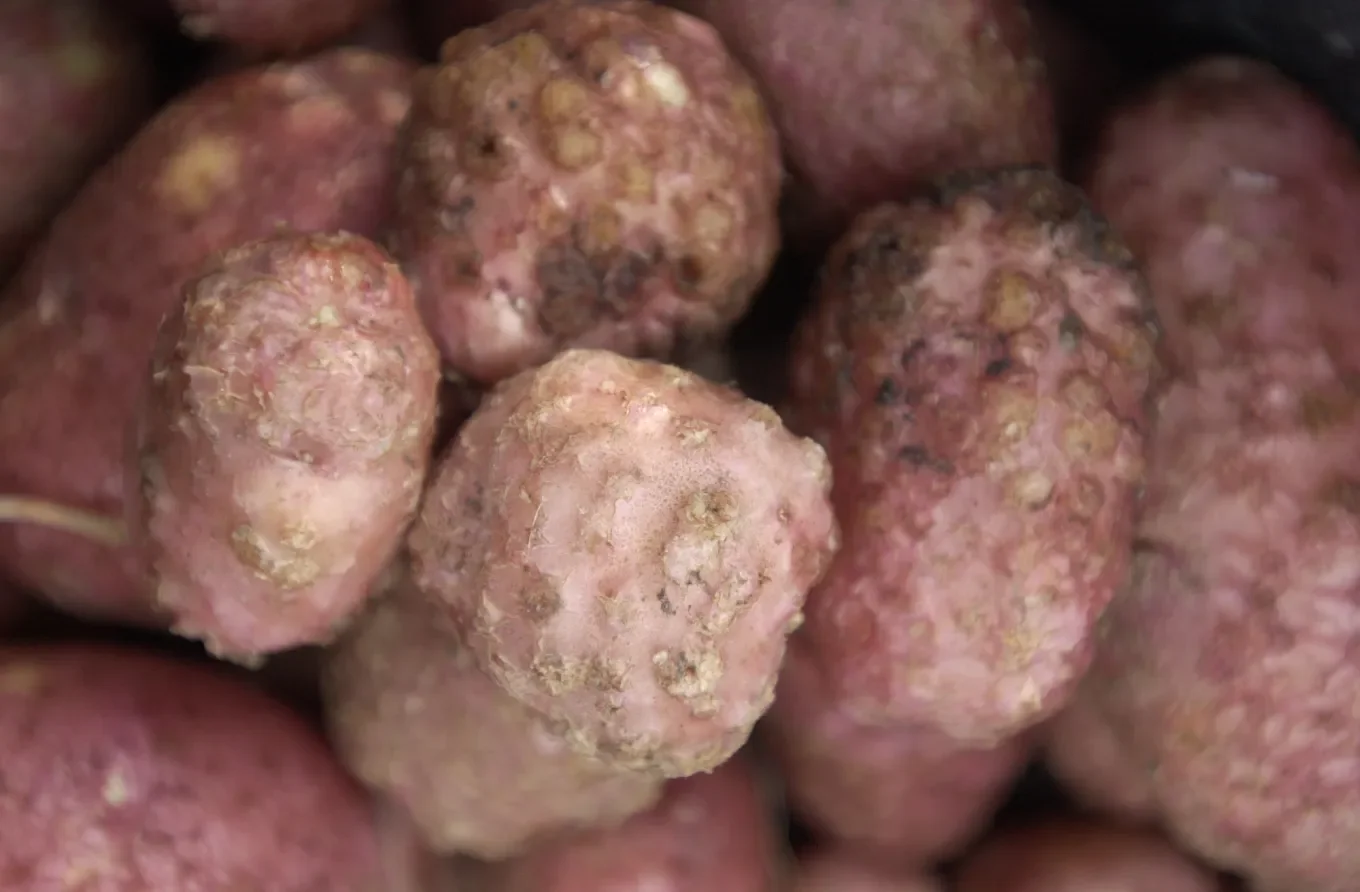
Potato tubers deformed by Meloidygne Chitwoodi (Source: WUR)
Veridi Technologies has achieved a breakthrough for global food supply. Plant-parasitic nematode infections destroy nearly 12% of annual food production worldwide, causing an annual economic loss of approximately USD 160 billion. To combat this problem Veridi Technologies, with support from the European Innovation Council (EIC), has developed the AI-driven NEMASCOPE®, a diagnostic platform for accurate and rapid nematode identification. NEMASCOPE® has now passed a critical field trial at Wageningen University & Research (WUR). The results demonstrate that the NEMASCOPE®’s performance essentially matches that of manual experts. This heralds a new era in nematode diagnostics: availability of these experts is limited worldwide and steadily decreasing, while manual labor is expensive. The NEMASCOPE™ enables accurate, transparent, and rapid large-scale soil diseases testing at significantly lower costs.
WUR researcher Ir. Leendert Molendijk commented on the field trial results: "These impressive results prove that AI-assisted microscopy and computer vision has the potential to achieve expert-level accuracy in pest nematode diagnostics."
Ir. Ziad Matar, CEO at The Hague-based Veridi Technologies, which now operates globally: "This technology will allow millions of farmers worldwide to effectively manage nematode pests, making farming more sustainable, and more profitable.”
In the coming year, Veridi Technologies and its partners will further expand the capabilities of the NEMASCOPE® platform to other abundant pest nematodes and develop diagnostics to assess soil health and biodiversity.
The Bottleneck in Nematode Ecology Analysis
Root knot nematodes (RKN) are among the most economically damaging plant-parasitic nematodes in the world. Species-level diagnostics are essential for sustainable control of this pest through advice to farmers on appropriate crop rotations, crop varieties, and pesticides. Meloidogyne chitwoodi and Meloidogyne fallax species in particular are the most damaging, quarantine-regulated pests in global agriculture. Yet their morphological similarity makes accurate identification exceptionally challenging, even for experienced nematologists.
To address the growing global shortage of these experts, Veridi Technologies has developed the NEMASCOPE® diagnostic platform. The system consists of an industry-ready end-to-end solution, integrating proprietary imaging hardware with machine learning infrastructure capable of classifying numerous nematodes at scale.
WUR Blind Validation Trials
The NEMASCOPE® nematode identification performance was evaluated via blind validation trials conducted in collaboration with the WUR Arable Farming business unit. The trial included diverse field samples known to be infested with the plant-parasitic root-knot nematode, which were provided to Veridi Technologies without prior disclosure of Meloidogyne species composition. During the validation trial, both the NEMASCOPE® system and a WUR nematologist independently identified each nematode. The expert identification served as the benchmark for accuracy assessment.
Compared to manual identification, the AI-based approach achieved approximately 95% accuracy in identifying RKN genera, with species-level prediction accuracy for M. chitwoodi of approximately 96%, essentially matching the performance of manual experts. This trial represents the first demonstration of automated and high-throughput species-level discrimination of Meloidogyne pest nematodes in agricultural field samples, under blind conditions, on the market.
EU Soil Monitoring Law
Within the context of a European Innovation Council grant, Veridi Technologies and WUR are building on this initial success to perform additional trials and research to expand the NEMASCOPE®’s capabilities to non-parasitic, free-living nematodes. Nematodes are not just parasites, but also function as excellent indicators of soil biodiversity. This subject is gaining importance due to the newly adopted European Soil Monitoring Law.
Veridi Technologies, founded in 2022, has gained widespread recognition. In 2025, the European Union awarded the company an EIC Accelerator grant. Last year, Veridi Technologies was also selected for the global top 500 most promising AgriFoodTech companies of 2025. Moreover, the company received Bayer Golden Ticket II award last year, won an award at the Singapore Week of Innovation, and was ranked among the top 10 most innovative SMEs in the Agriculture, Infrastructure & Water category by the Dutch Chamber of Commerce.
Read the full article on the Wageningen University & Research website. For more updates, follow us on LinkedIn
